Comparison of Comet and Gluten#
This document provides a comparison of the Comet and Gluten projects to help guide users who are looking to choose between them. This document is likely biased because the Comet community maintains it.
We recommend trying out both Comet and Gluten to see which is the best fit for your needs.
This document is based on Comet 0.16.0 and Gluten 1.6.0.
Architecture#
Comet and Gluten have very similar architectures. Both are Spark plugins that translate Spark physical plans to a serialized representation and pass the serialized plan to native code for execution.
Gluten serializes the plans using the Substrait format and has an extensible architecture that supports execution against multiple engines. Velox and Clickhouse are currently supported, but Velox is more widely used.
Comet serializes the plans in a proprietary Protocol Buffer format. Execution is delegated to Apache DataFusion. Comet does not plan to support multiple engines, but rather focus on a tight integration between Spark and DataFusion.
Underlying Execution Engine: DataFusion vs Velox#
One of the main differences between Comet and Gluten is the choice of native execution engine.
Gluten uses Velox, which is an open-source C++ vectorized query engine created by Meta.
Comet uses Apache DataFusion, which is an open-source vectorized query engine implemented in Rust and is governed by the Apache Software Foundation.
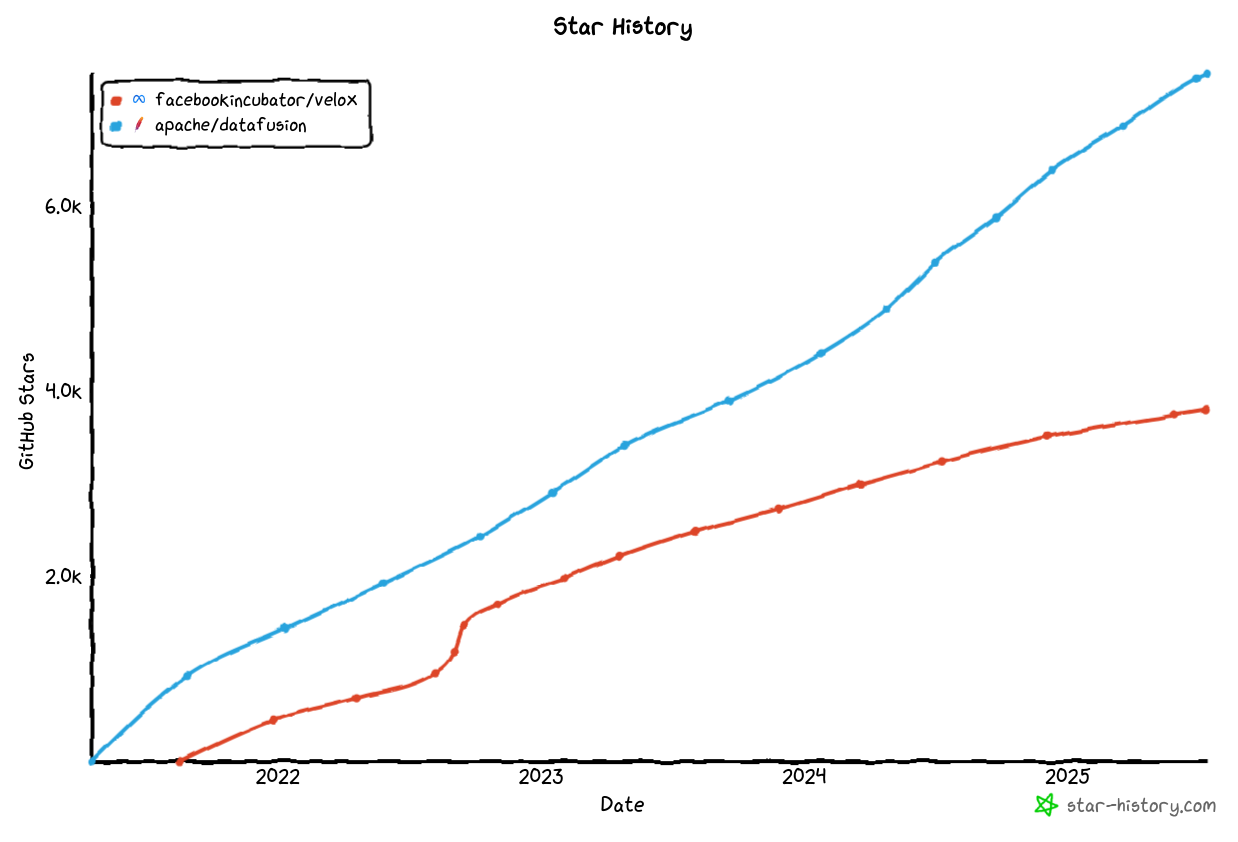
Velox and DataFusion are both mature query engines that are growing in popularity.
From the point of view of the usage of these query engines in Gluten and Comet, the most significant difference is the choice of implementation language (Rust vs C++) and this may be the main factor that users should consider when choosing a solution. For users wishing to implement UDFs in Rust, Comet would likely be a better choice. For users wishing to implement UDFs in C++, Gluten would likely be a better choice.
If users are just interested in speeding up their existing Spark jobs and do not need to implement UDFs in native code, then we suggest benchmarking with both solutions and choosing the fastest one for your use case.
Spark Version Support#
Both projects target a similar set of Spark releases.
Comet supports Spark 3.4, 3.5, 4.0, and 4.1 in production builds, with an experimental build also published for the Spark 4.2 preview. See the Spark version compatibility guide for the exact patch versions and JDK/Scala combinations.
Gluten supports Spark 3.3, 3.4, 3.5, 4.0, and 4.1.
ANSI Mode#
Spark 4.0 enables ANSI SQL semantics by default, which changes how arithmetic overflow, invalid casts, division by zero, and similar error conditions are handled. This is one area where the two projects currently differ.
Comet implements ANSI semantics for the expressions it supports natively, including arithmetic overflow checks,
ANSI cast behavior, and try_* variants. Queries running with spark.sql.ansi.enabled=true continue to be accelerated.
See the Comet Compatibility Guide for details on which expressions have full ANSI coverage.
The Gluten Velox backend documents that ANSI mode is not supported and that any query executed with ANSI enabled will fall back to vanilla Spark. See the Gluten Velox limitations page for the current status.
For users adopting Spark 4.0 without disabling ANSI mode, this difference can have a significant impact on the fraction of a workload that runs natively.
Table Format Support#
Both projects can accelerate queries against Apache Iceberg tables, but they take different approaches and Gluten covers a broader set of table formats overall.
Comet provides a native Iceberg scan built on iceberg-rust. It has been tested with Iceberg 1.5 through 1.10 and supports Iceberg spec v1 and v2, schema evolution, time travel and branch reads, positional and equality deletes on merge-on-read tables, REST catalogs, and S3-compatible object storage. Iceberg writes still go through Spark. Comet does not currently provide native integrations for Delta Lake, Hudi, or Paimon. See the Comet Iceberg guide for the full list of supported features and known limitations.
Gluten ships dedicated modules for Iceberg, Delta Lake (2.0 through 4.0), Hudi, and Paimon. Users who need native acceleration for Delta, Hudi, or Paimon will find broader coverage in Gluten today.
Compatibility#
Comet relies on the full Spark SQL test suite (consisting of more than 24,000 tests) as well its own unit and integration tests to ensure compatibility with Spark. Features that are known to have compatibility differences with Spark are disabled by default, but users can opt in. See the Comet Compatibility Guide for more information.
Gluten also aims to provide compatibility with Spark, and includes a subset of the Spark SQL tests in its own test
suite. See the Gluten Velox backend limitations page for known gaps, including notes on case sensitivity, regular
expression dialect (RE2 vs java.util.regex), NaN handling, and timestamp encodings.
Performance#
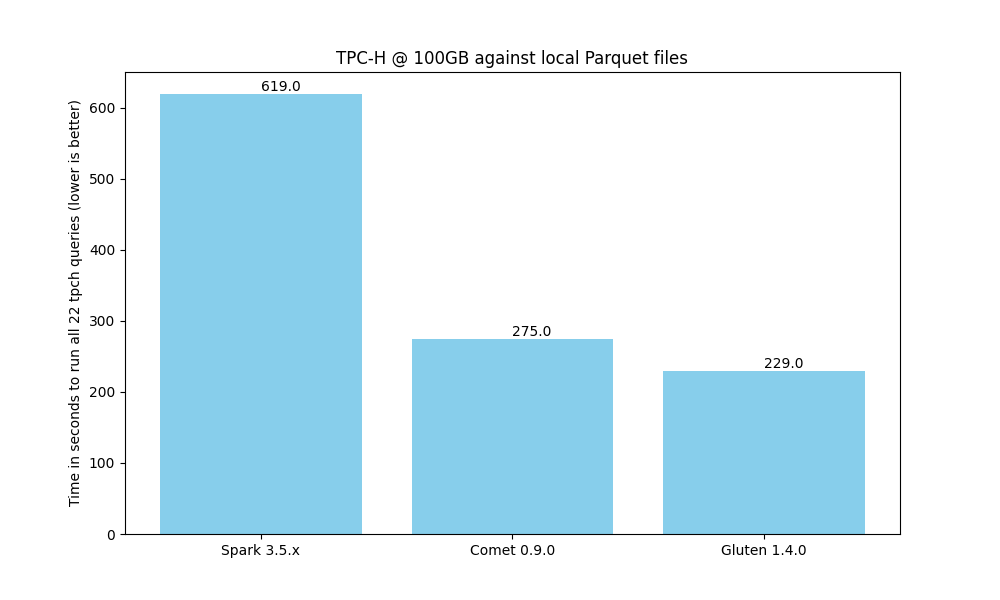
When running a benchmark derived from TPC-H on a single node against local Parquet files, we see that both Comet and Gluten provide an impressive speedup when compared to Spark. Comet provides a 2.4x speedup compares to a 2.8x speedup with Gluten.
Gluten is currently faster than Comet for this particular benchmark, but we expect to close that gap over time.
Although TPC-H is a good benchmark for operators such as joins and aggregates, it doesn’t necessarily represent real-world queries, especially for ETL use cases. For example, there are no complex types involved and no string manipulation, regular expressions, or other advanced expressions. We recommend running your own benchmarks based on your existing Spark jobs.
The scripts that were used to generate these results can be found here.
Ease of Development & Contributing#
Setting up a local development environment with Comet is generally easier than with Gluten due to Rust’s package management capabilities vs the complexities around installing C++ dependencies.
Summary#
Comet and Gluten are both good solutions for accelerating Spark jobs. Comet currently has an edge for users on Spark 4.0 with ANSI mode enabled, and for users who want a fully native Iceberg scan path. Gluten currently leads on TPC-H performance and offers broader native integration with Delta Lake, Hudi, and Paimon, plus a second backend in ClickHouse. We recommend trying both to see which is the best fit for your needs.